
This post's title promises that a raw diet makes weight loss easy. One thing a plate of raw vegetables, fruit and nuts does bring is fibre, and one analysis of a weight loss trial found fibre intake was the most influential predictor of how much people lost. Dates carry a fair amount of it, though not enough to do the job alone.
What a weight loss study found about fibre
POUNDS Lost was a randomised trial that put adults on calorie-restricted diets, each cut by 750 kcal a day from their estimated needs and varying in their mix of macronutrients. In 2019 a team re-analysed the food records of 345 of its participants (PubMed 31174214). After 6 months their weight had changed by an average of minus 7.27kg.
The researchers looked for what predicted how much each person lost. Their best model included several factors, among them energy density, fat, age and how well people kept to their diet. The most influential predictor was fibre intake. Fibre was also strongly linked with how closely people stuck to their assigned diet.
The authors concluded that fibre intake, independently of macronutrient and calorie intake, promotes weight loss and dietary adherence in adults with overweight or obesity on a calorie-restricted diet. It is worth reading that in context. These were people already eating fewer calories under a study plan, and this was a later analysis of their records, not a separate trial that gave one group more fibre.
How much fibre the NHS asks for
The NHS says government guidelines put adult fibre intake at 30g a day, as part of a healthy balanced diet. Most adults eat an average of about 20g, so the gap is around 10g a day. The same page sets a simple label rule: high-fibre foods have 6g or more of fibre in every 100g.
Dates against the 6g rule
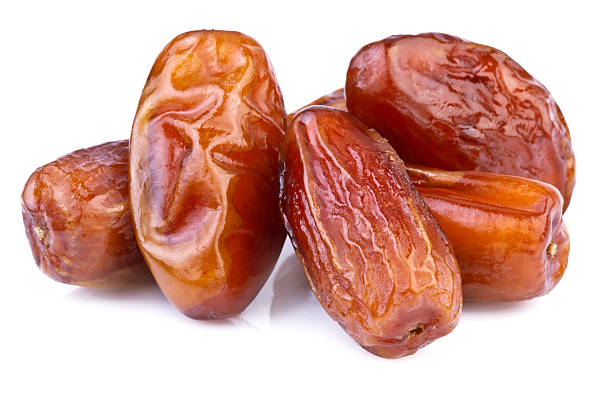
USDA FoodData Central lists Medjool dates at 6.7g of fibre per 100g, which clears the NHS 6g line. One pitted Medjool weighs about 24g, so a single date gives about 1.6g of fibre.
The catch is what comes with it. That same date carries about 66 kcal and 16g of sugars. Covering the whole 30g with Medjool alone would take about 19 dates, close to 1,260 kcal. Raw carrot has 2.8g of fibre per 100g at 41 kcal, and a raw apple with skin 2.4g at 52 kcal, so per calorie carrot gives nearly three times as much fibre as Medjool, and apple about twice as much.
The NHS fibre page makes the same point in a different way. It says to get fibre from a variety of sources, because eating too much of one type of food may not give you a balanced diet. It also suggests fresh or dried fruit for dessert, and adds that because dried fruit is sticky it is better eaten as part of a meal than as a snack between meals. On a raw plan, that puts a date or two at the end of a meal, with raw vegetables and fruit filling out the rest of the day.

Nuts and juice, the two items from the old post
The older version of this post recommended almonds as a filling snack. FoodData Central gives almonds 12.5g of fibre per 100g, and the NHS lists a small handful of nuts such as almonds as one way to raise your daily fibre, as long as they are unsalted and have no added sugars. They are also dense, at 579 kcal per 100g, so the handful should stay small. For readers who followed the old post's link to find more information it is still here.
The old post also suggested a glass of freshly squeezed vegetable juice as a meal. The NHS counts fruit juice, vegetable juice and smoothies as one portion of your 5 A Day at most, and says to limit them to a combined 150ml a day, because crushing fruit and vegetables releases the sugars they contain. Whole fruit and vegetables are counted differently: the NHS says 80g of fresh, canned or frozen fruit and vegetables counts as 1 portion.
Ordering dates
Kurma Borong Malaysia handles orders from retail buyers up to wholesale supply and delivers them across Malaysia, as its about us page explains. Contact is through WhatsApp, given on the contact us page. More date guides are on the Kurma Borong blog.
This article is general information, not personal advice. Talk to your GP or a dietitian before making a big change to your diet.