
This list leaves out studies that measured a single test lunch. It keeps to foods that were studied for days, weeks or months. That shorter list is still five long, if you allow the last item to be a drink. Read the numbers, though. Not one of them is dramatic.
1. Half a fresh grapefruit before meals
At Scripps Clinic in California, 91 people with obesity took one of four options three times a day before each meal for 12 weeks: half a fresh grapefruit, a glass of grapefruit juice, grapefruit capsules, or a placebo capsule with apple juice (PubMed 16579728). The fresh grapefruit group lost 1.6kg, significantly more than the placebo group's 0.3kg. The juice group lost 1.5kg and the capsule group 1.1kg.
A later trial at Vanderbilt University put that result in context (PubMed 21288350). It gave 85 adults with obesity 127g of grapefruit, grapefruit juice or water before breakfast, lunch and dinner for 12 weeks, alongside a lower-calorie diet. The three starters were matched for weight and calories. People lost 7.1% of their body weight on average, and the differences between the three groups were not statistically significant. The authors concluded that the form of the starter made no difference to weight loss.
2. Whole grains in place of refined ones
At the Jean Mayer USDA Human Nutrition Research Center on Aging, 81 men and postmenopausal women aged 40 to 65 were fed one of two diets for six weeks (PubMed 28179223). One had 207g of whole grains and 40g of fibre a day. The other had no whole grains and 21g of fibre. Calories were set to keep weight steady, and it did stay steady.
The whole-grain group still came out ahead on energy. Their resting metabolic rate was 43 kcal a day higher, and 57 kcal a day more energy left the body in stool. Added together, the authors put the extra net energy loss at 92 kcal a day. When people who did not stick to the diet were taken out, the metabolic rate difference was no longer significant. One author was from General Mills.
3. Fruit and vegetables, with less fat
This trial ran for a whole year at Penn State (PubMed 17556681). It assigned 97 women with obesity to one of two kinds of advice. One group was told to cut fat. The other was told to cut fat and eat more water-rich foods, particularly fruit and vegetables. Neither group was given a calorie target, and both could eat as much as they wanted while following their advice.
Of those who finished, the fruit-and-vegetable group lost 7.9kg against 6.4kg. They also reported less hunger. Both groups cut fat by similar amounts. The difference was that the second group ate a greater weight of food, especially fruit and vegetables, which lowered the energy density of their diet.
4. Vegetables and fruit when portions grow
Another Penn State study fed 23 adults all of their food for two periods of 11 days each (PubMed 17557991). In one period every portion was standard. In the other, every portion was 50% bigger. On the bigger portions, people ate 423 kcal more a day, and it did not wear off. By day 11 the extra had added up to 4,636 kcal.
The bigger portions raised intake at every meal and for every kind of food, except two: fruit eaten as a snack, and vegetables. Serving more of those did not significantly raise intake. If your plates are getting bigger anyway, these are the foods to let grow.
5. Plain water before each main meal
Strictly, number five is a drink. At Virginia Tech, 48 adults aged 55 to 75 followed a lower-calorie diet for 12 weeks (PubMed 19661958). One group also drank 500ml of water before each main meal. That group lost about 2kg more than the diet-only group.
The authors suggest this may be partly due to eating less at meals after the water. At the start of the trial, 500ml of water did lower intake at a test meal. By week 12 the difference was no longer significant.
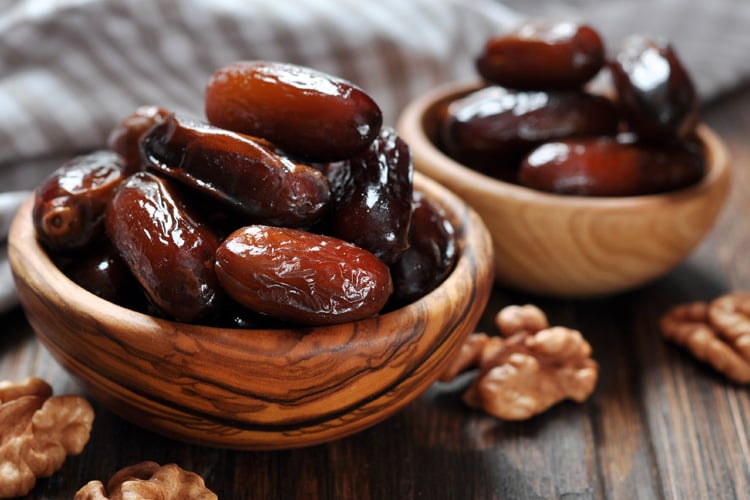
What this means for a box of kurma
Put together, the five point to a light starter, more whole grains, more fruit and vegetables, and water before eating. None of these five trials used dates. USDA FoodData Central lists Medjool dates at 277 kcal per 100g, with 6.7g of fibre.
The NHS counts a 30g portion of dried fruit, and it names dates in that list, as one of your 5 A Day. It also says to eat dried fruit at mealtimes, not as a snack between meals, to reduce the impact on teeth. A 30g portion of Medjool is about 83 kcal. Weigh it once, so you know what 30g looks like, and keep it with a meal rather than at your desk. The portion study above found that people ate more of most foods simply because more was served.
Ordering from Kurma Borong Malaysia
Kurma Borong Malaysia handles everything from retail purchases to wholesale supply and delivers across the country, according to its about us page. Questions, price quotes and orders go through WhatsApp, listed on the contact page. More articles on dates are on the Kurma Borong blog.
The earlier version of this post linked to https://KurmaHarga.com. That link stays.
This article is general information, not personal advice. If you plan a big change to the way you eat, speak to your GP or a dietitian first.